


Myopia and MiSight
Myopia: A Growing Problem Affecting Children and Teens’ Vision
Is your child struggling to see the board in class or distant objects clearly?
Myopia, or nearsightedness, is becoming more common among children worldwide. Thankfully, with cutting-edge advancements in eye care, there’s a revolutionary way to manage this condition and help your child see better.
As a parent, you want the best for your kids, especially when it comes to their health and well-being.

Don’t wait, schedule an appointment with your eye doctor today to discuss myopia management options for your child.
Meet FDA-Approved MiSight®
A Breakthrough in Children and Teens’ Eye Health
MiSight 1 day is a daily disposable contact lens option used in myopia management. An optometrist must assess whether your child meets the current product criteria and can use contact lenses safely. Myopia management aims to slow progression; it does not cure myopia or guarantee an individual result.
Starting myopia management early with MiSight 1-Day contact lenses can make a significant difference in your child’s vision and overall eye health.
Give your child the gift of clear, comfortable vision.
These revolutionary daily disposable lenses not only correct your child’s vision but also work to control the progression of their myopia. With MiSight® 1 day, your child can experience the joy of clear vision without the limitations and frustrations that come with glasses.
Schedule an appointment with your eye doctor to discuss if MiSight® 1 day is right for your child.
Experience the revolutionary technology behind MiSight® 1 day.
Here’s how it works:
- Two treatment zones create myopic defocus with image focus in front of the retina, rather than behind it, to slow axial elongation.
- Two correction zones correct myopia in all gaze positions, ensuring clear vision for your child.
MiSight 1 day uses a dual-focus lens design. Discuss the evidence for myopia control with your child’s optometrist, including how progression will be assessed and the limits of predicting long-term outcomes for an individual child.
The Benefits of MiSight 1 Day for Your Child
Unlock your child’s potential with the life-changing benefits of MiSight® 1 day.
By choosing MiSight 1 day for your child, you’re not only helping to manage their myopia but also giving them the gift of:
- Clear, comfortable vision all day long, without the hassle of glasses or traditional contact lenses.
- The freedom to participate in sports and other activities without worrying about their vision.
- Increased confidence and self-esteem, as they’ll feel more like themselves without the need for corrective eyewear.
- A reduced risk of developing serious eye conditions later in life, thanks to the myopia control benefits of MiSight 1 day.

Your child deserves the best. Schedule an appointment with your eye doctor today to discuss if MiSight® 1 day is right for your child.

MiSight vs. Orthokeratology: Comparing Myopia Management Techniques
When it comes to helping children with myopia, there are two great options: MiSight lenses and Orthokeratology (Ortho-K). They work differently and each has its own benefits.
MiSight lenses use dual-focus technology and are worn as daily disposable soft contact lenses. All contact lenses require careful handling and hygiene. Discuss lens care, possible complications, and your child’s readiness with the prescribing optometrist. See the CDC’s contact lens guidance.
On the other hand, Orthokeratology (Ortho-K) uses rigid gas permeable (RGP) lenses to reshape the cornea while sleeping. This non-surgical procedure allows for clear vision during the day without needing glasses or contact lenses. Although it’s effective in slowing myopia progression, it requires extra care and maintenance, and children need to learn how to handle and care for the lenses
Schedule an appointment with your eye doctor at All Eye Care Doctors & EYESPOT today to explore the best myopia control for your children & teens.
Understanding the Causes of Myopia
It’s natural to feel concerned and even a little overwhelmed when you notice your child squinting at the television or complaining that they’re not able to read the board in school. You may find yourself wondering, “Is this normal? Should I be worried?”
The truth is, you’re not alone in your worries. Many parents today are facing the same challenges as the number of children diagnosed with myopia, or nearsightedness, continues to rise at an alarming rate.
But what’s causing this myopia epidemic?
- Genetics
If you or your partner are myopic, your child may be more likely to develop myopia. - Insufficient time spent outdoors
Kids need to spend time outside, enjoying natural light and taking breaks from close-up work. - Prolonged time spent on digital devices
In our digital age, children are spending more time than ever staring at screens, which can contribute to vision issues. - Poor lighting levels
Inadequate lighting while reading or doing close-up work can strain your child’s eyes.
The Impact of Myopia on Your Child’s Life
Myopia can affect your child’s life in many ways, both now and in the future. Without proper management, myopia can lead to:
- Difficulty seeing the board at school, which can impact their learning and academic performance.
- Struggle with sports and other physical activities, as poor vision can affect hand-eye coordination and depth perception.
- Increased risk of developing more serious eye conditions later in life, such as retinal detachment, glaucoma, and cataracts.
- Reduced self-esteem and confidence, as your child may feel self-conscious about wearing glasses.
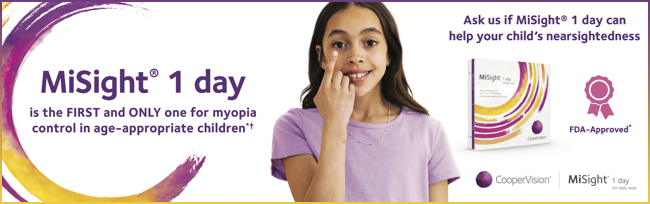
Your child deserves the best.
Schedule an appointment with your eye doctor today to learn about myopia management options.
Take the first step towards a brighter future for your child.
Schedule an appointment with your eye doctor at All Eye Care Doctors & EYESPOT in Cambridge, MA, today to discuss MiSight® 1 day!
Questions to ask at a myopia consultation
Myopia makes distant objects appear blurry. Myopia management aims to slow progression and does not cure nearsightedness. Read the National Eye Institute’s explanation of myopia.
Discuss these steps with your child’s optometrist: assessment of vision and eye health; suitability and alternatives; contact lens fitting; handling and hygiene education; an initial follow-up; and ongoing monitoring. Your clinician will specify the tests and intervals appropriate for your child.
Ask about current MiSight product criteria, your child’s ability to manage daily lenses, expected benefits and limits, total costs, and what to do if a lens feels uncomfortable. Read the profiles of Dr. Enian Kallamata and Dr. Maryam Fatouraei and contact the office to confirm appointment and service availability.
Serving Greater Boston through offices in Medford, Cambridge, Burlington, Chestnut Hill, and Wellesley. Contact your preferred office to confirm the treatment location, clinician availability, and appointment details.